Most meetings are not bad because the people in them are bad. They are bad because no one was responsible for making them good. The default setting of a meeting, left to itself, is a slow drift through whatever happens to be on people's minds, followed by a vague sense that something was decided. A useful meeting takes a small amount of work to set up and a small amount of discipline to run. It is not a mystery, and it does not require charisma. It requires a few rules, applied consistently, by whoever called the meeting.
Here are the ones that hold up.
Decide whether the meeting should exist at all
The cheapest way to run a meeting well is to not run it. Before you put time on someone's calendar, ask whether a written update would actually serve the same purpose. If the meeting is mostly one person briefing the others, the answer is almost always yes. A short document, read silently, gets information into people's heads faster than any presentation, and it leaves a searchable record behind.
Meetings earn their place when they involve genuine deliberation. If a group needs to react to something in real time — to ask follow-up questions, to negotiate, to disagree and resolve the disagreement — synchronous time is the right tool. If a group needs to be informed, written word almost always wins. The test is whether the meeting will produce something that a Loom video and a comment thread could not have produced.
Write an agenda you would be willing to follow
The agenda is the meeting. If the agenda is weak, the meeting will be weak. If the agenda is strong, the meeting will, at worst, be tolerable.
A useful agenda has three properties: it lists outcomes rather than topics, it puts the most important item first, and it can be read in under thirty seconds. "Discuss Q3 planning" is a topic. "Decide which two initiatives to defer from Q3" is an outcome. The difference is whether anyone in the room will know, an hour later, whether the meeting succeeded.
Start with the decision needed
If your meeting requires a decision, name it in the first line of the agenda and address it in the first five minutes of the meeting. The temptation is to save the decision for the end, after the group has been warmed up by context. Resist this. Energy drops as the meeting goes on, not up. The decision deserves the freshest minds in the room, and putting it first also creates a useful pressure to cut anything that does not feed it.
Cap each item with a time
Next to every agenda item, write a number of minutes. Not because you will hit it exactly, but because the act of estimating forces a kind of honesty about which items are worth what. An agenda with "Q3 planning — 45 min" and "Vendor demo — 5 min" tells everyone in the room how the time is meant to be spent. An agenda without times invites the loudest topic to absorb the rest.
Set the room up to actually work
Some of what makes a meeting good is logistical, and most of it is decided before anyone arrives.
The right people should be there, and only the right people. The right number of people is the smallest set who can make the decision or reach the conclusion. Each additional person doubles the implicit social cost of a hard exchange and halves the chance that the hard exchange happens. If someone needs to be informed but does not need to decide, they belong on the notes distribution, not in the meeting.
The room — virtual or physical — should be ready. Documents linked. Screen shared before the start time. A note-taker assigned in advance, by name, not by hopeful glance. Whoever called the meeting facilitates it, unless they have explicitly handed that off to someone else. The facilitator's job is to enforce the agenda, not to be the smartest voice in the room.
Default to twenty-five minutes, not thirty
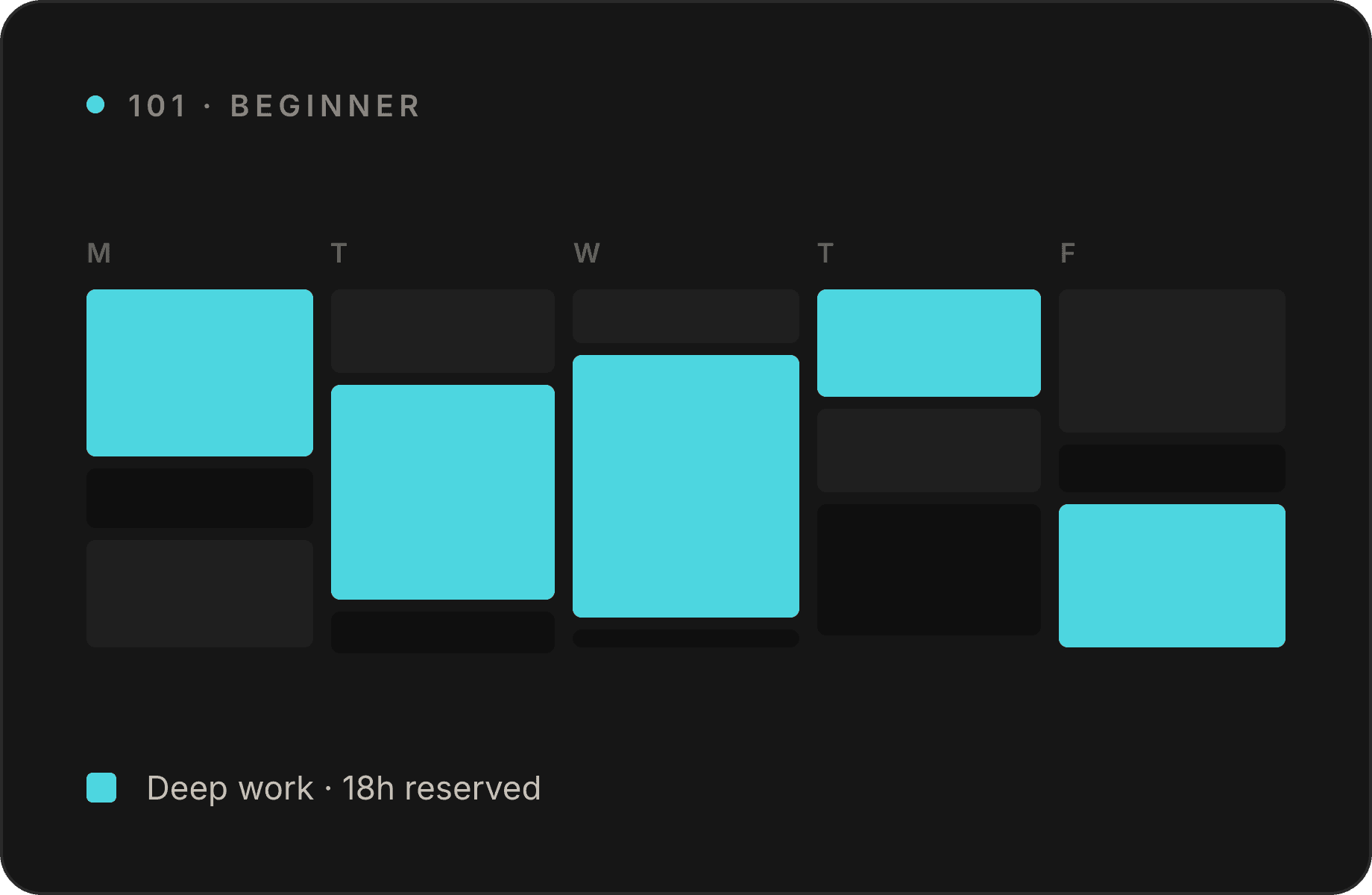
Almost every meeting you have ever attended that was scheduled for thirty minutes could have been twenty-five. Almost every meeting scheduled for an hour could have been fifty. The reason most meetings run the full block is that they are scheduled to. Time fills the container you give it.
Defaulting to twenty-five or fifty also has a second-order effect: it leaves a five-minute buffer between back-to-back meetings, which is the actual width of "a moment to think." A team that runs on this default is measurably less frazzled by the end of the day, even when the total meeting load is unchanged.
Close with the next action, every single time
The single highest-leverage habit you can build into the end of a meeting is the explicit close. In the last two minutes, the facilitator says, in order: what was decided, what the next action is, who owns it, and when it is due. Then they write it down where everyone can see it, and someone confirms it before the meeting ends.
If you cannot close it, name what is missing
Sometimes a meeting does not produce a decision. That is not a failure, but it is a thing to be honest about. If the close cannot happen, the facilitator should say what is missing — a piece of data, an absent stakeholder, a disagreement that needs more time — and what would have to change before the decision is possible. Then they should schedule the next step, not just hope it appears.
The worst version of a meeting is one that ends in a fog, with everyone walking out half-sure something was agreed and unsure what they are supposed to do next. The named-gap close prevents that, even when it cannot prevent the gap itself.
A short closing argument
None of these rules are clever. None of them require a special tool. They require one person, on each meeting, deciding that this hour is going to be worth the time of the people in it. That person is usually the one who called the meeting, and usually they have been given no training on how to do it.
If you are that person on the next meeting on your calendar, you have all the rules you need. The hard part is not knowing them. The hard part is being the one who applies them when the room would prefer to drift.